
Safer Streets in Santa Monica
The Big Blue Bus Adopt-A-Stop started a year and a half ago: volunteers officially choose a specific bus stop, receive cleaning supplies to wipe down seating, and report any problems. Sirinya adopted her local 26th Street and Santa Monica Boulevard stop because it was consistently dirty and she used the stop regularly. Having previously worked on bus shelter projects, she understood that the larger problem was the vacant storefront behind the bus stop. The area became a magnet for trash, illegal dumping, illegal advertising, and general neglect. “City staff were already power-washing the area frequently, but couldn’t outpace the desolution.
Adopting the stop gave Sirinya a standing to advocate for the adjacent property to be maintained. Working with city staff, documented conditions with photos, filed regular 311 tickets, contacted the property owner, researched relevant municipal codes, challenged unauthorized advertising, and connected with someone knowledgeable about the property's redevelopment potential. Eventually, the city intervened. The property owner was cited and required to address the problems, and the area became noticeably cleaner, which in turn signaled a safer place to wait for the bus.
As with most civic action, transportation advocacy focuses on the long view. “Lasting change doesn't necessarily come from personally cleaning a bus stop forever, but is often the first step to improvements,” Sirinya said. Once we pause long enough to note our surroundings and the feelings they spark, we can act by identifying the underlying problem, documenting it, building institutional knowledge, engaging the responsible parties, and creating accountability.
Cleaning a bus stop might seem small, but it has far-reaching effects. Anyone, including seniors, who need to sit while waiting for a bus will eschew this mode if the seating is too dirty. With buses’ smoothly lowered platform, this form of transportation should be a good option for anyone traveling on busy streets such as Wilshire. There is a senior TAP card/phone app with lower fares, and Metro has a senior program called On the Move, which pairs seniors with a buddy to help them use transit.
James joined Santa Monica Forward at the end of June as a community organizer. His current focus: initiatives to make streets near schools safer for children. “School drop-off is a chaotic situation, but it’s more productive to view school traffic as a microcosm of a larger societal problem, rather than simply blaming cars and drivers,” James said.
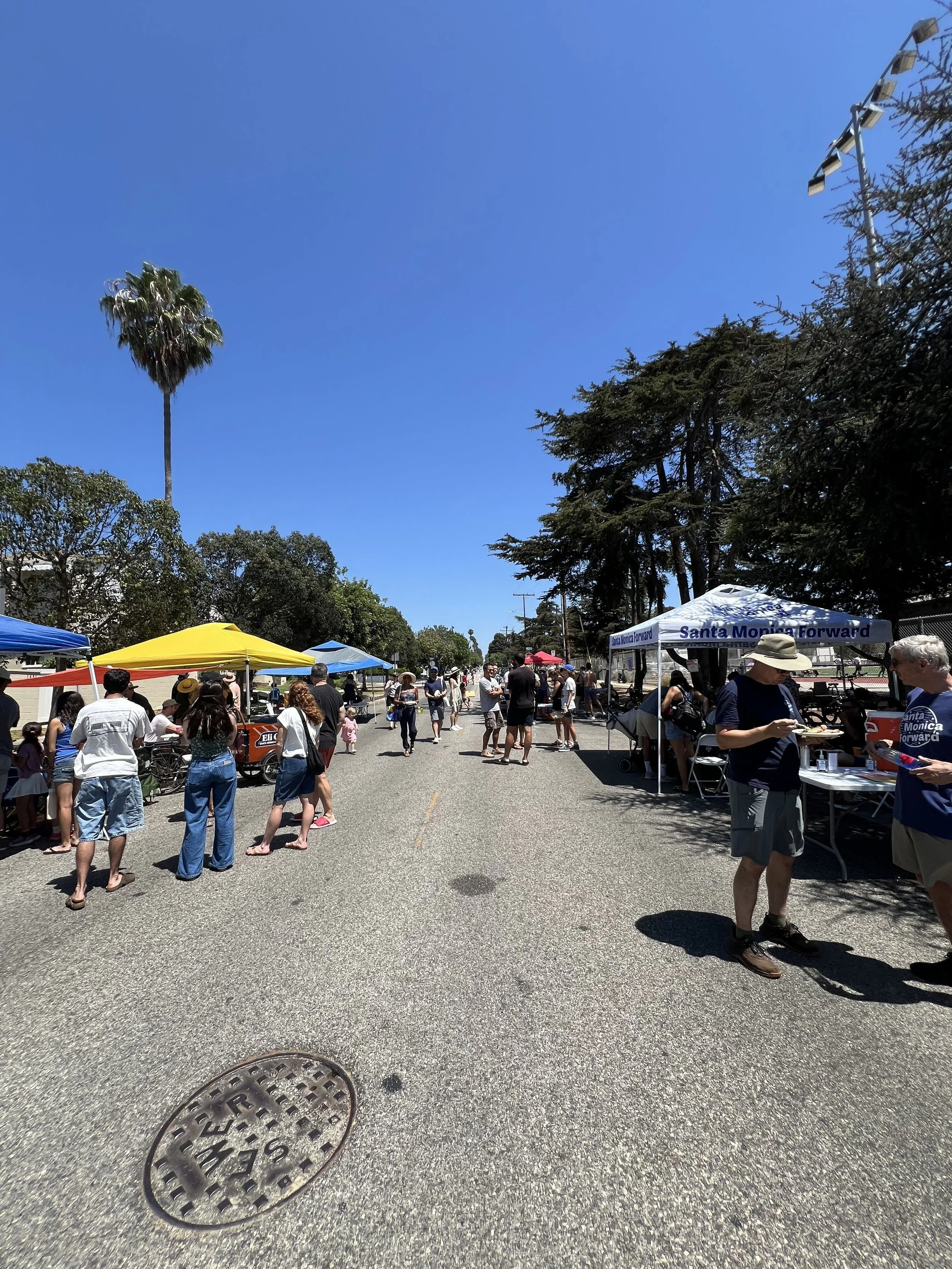
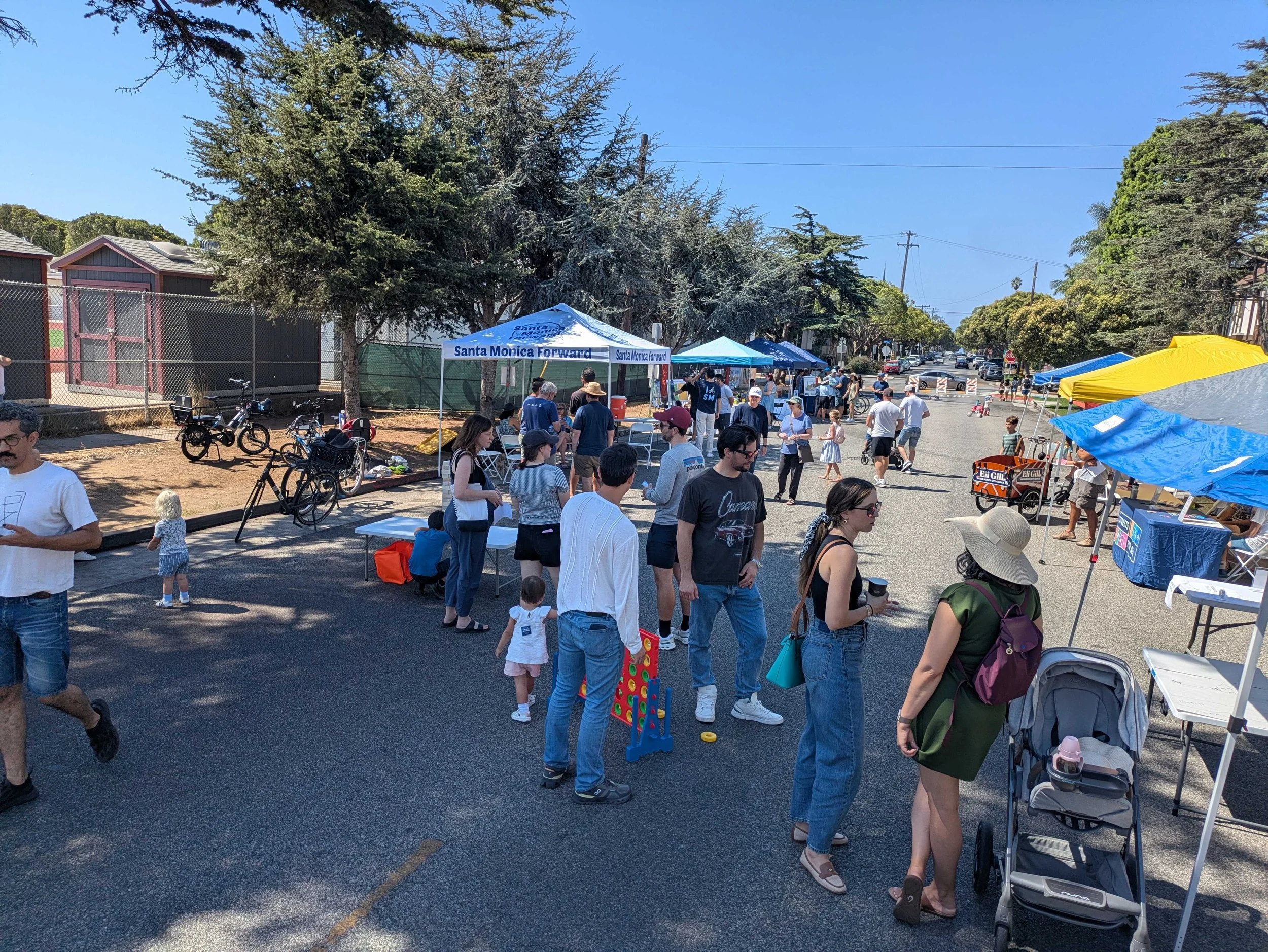
Santa Monica Forward held a block party called “Play Streets” took place a few weeks ago on Saturday, August 22nd. The block party’s main goal was to raise awareness for the Safer Streets initiative and to demonstrate the real-time reclaiming of a safe space for people, rather than cars. By closing off Washington Avenue to cars from 10 a.m. to 2 p.m., people from all over the city enjoyed the neighborhood around Lincoln Elementary School as a car-free space. Kids scooted, biked, and drew with chalk. The celebration continued with food, a raffle, and planned activities, such as a bingo game designed for the event, modeled on Priya Parker’s The Art of Gathering.
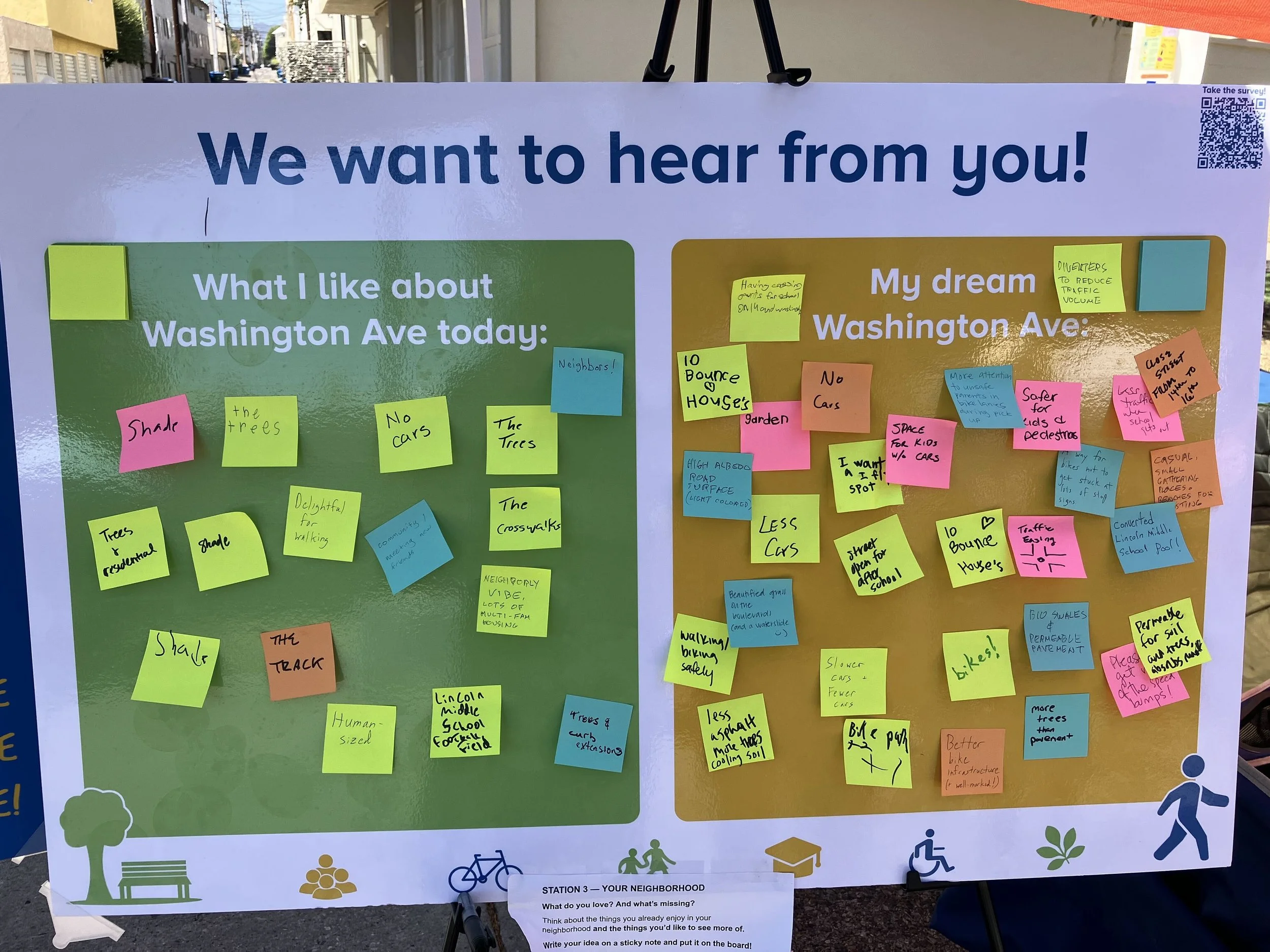
Play Streets attendees added their ideas to an on-site poster board listing pop-up ideas for safer, closer-knit, and more sustainable communities—which includes regaining economic sustainability through more expansive street closures. Ideally, this pop-up wish list will grow into an interactive/electronic community-input board.
Whereas permanent changes might take years, seeing with our own eyes how streets can expand beyond functionality as transportation corridors to bloom into centers for community moves the needle towards safety in both the figurative and literal sense, transporting us beyond lack of harm to sites of harmony, reorientation, and support.
I know firsthand how a community of car-free and car-lite families creates cohesion. My family lived on a very steep street in the Jamaica Plain neighborhood of Boston from my son’s third birthday to his 13th. Cranston Street essentially functioned as a dead-end. The lack of traffic created an almost shared living room where people met, parents chatted on porches, and looked out for all the kids on the street who safely biked, scooted, and ran around in an age-diverse gang. The concept of safe streets can be adapted to local climate and geography as long as the culture at least nudges towards it.
James summed up the group goal: “None of us has to do it perfectly or in the same way as anywhere else to create safer streets. We can all just take the next step.”
Jessica Cole
