
Book clubs as Community Connectors
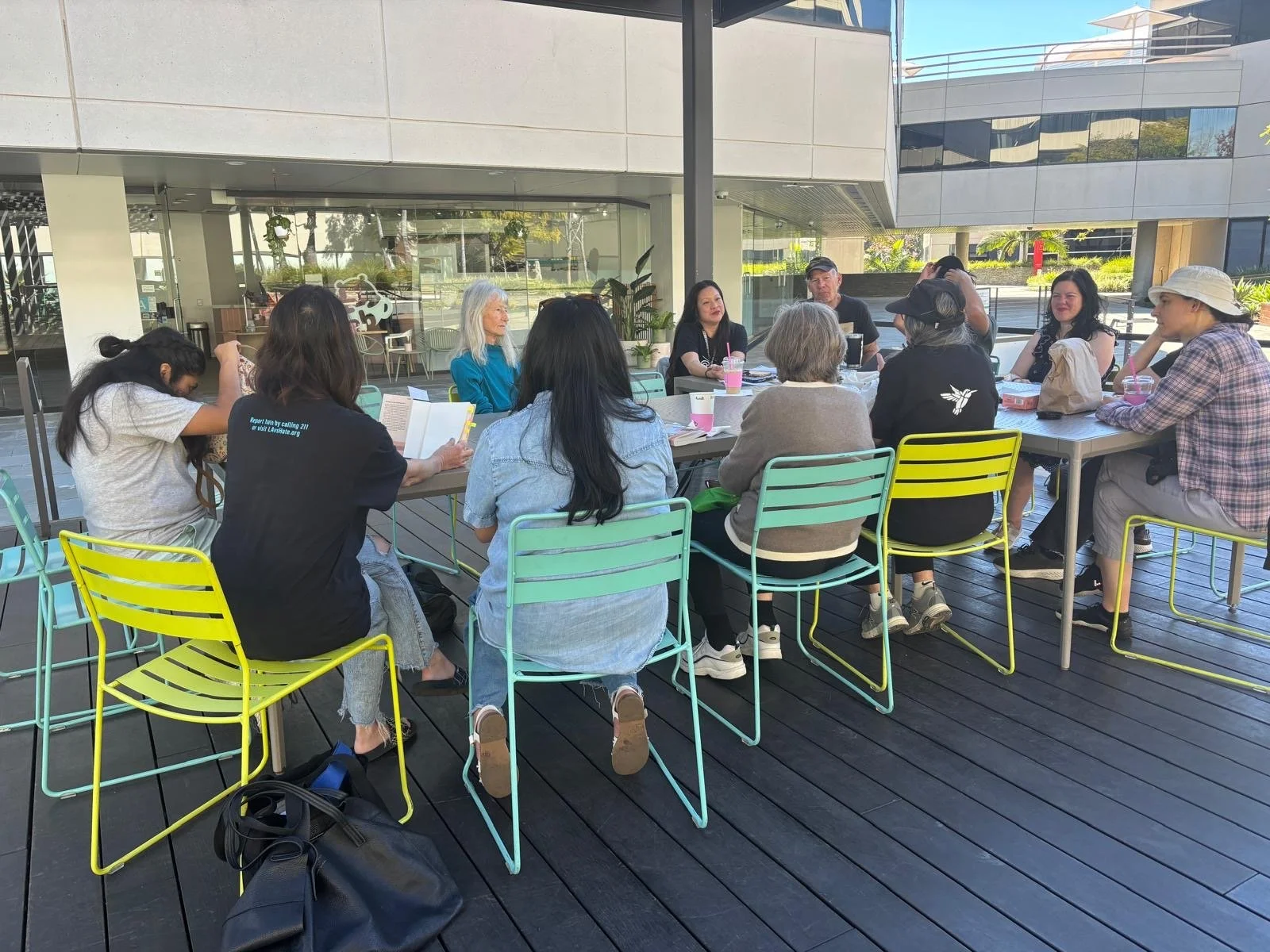
Bookreading—universally admired cultural cache, escape hatch, compassion generator, loneliness buster, mental health boost, source of guilt. The physical copies accent curated home decor and reveal parts of our secret selves to visitors. Their bulk clutters small urban apartments, shedding themselves as dust. We all say we want to engage more often with books rather than social media posts, but how do we choose among the thousands of titles published each month and marshal the attention to sink into longform?
Here at Bahala, we’ve been playing around with ways to enfold books and reading into our programming. It fits with our mission to activate community connections to not only break down barriers between people, but to dilute obstacles and concentrate our intentions. Local author Suzanne Park led a recent Tea & Talks. She answered questions about her writing process and helped us find our wacky humor prompted by memes. Library Director Erica Cuyugan stopped by Coffee & Connections to chat about the Santa Monica Reads program and the library’s innovative book club kits.
As with all endeavors involving groups and goals, book clubs offer a way to practice democracy—complete with its Swiss Army knife of approaches. To reduce the friction of disorientation, multi-directional steps, and choice-overwhelm, we know that challenges become more bite-sized once they’re identified, named, shared, and discussed. In this two-part series, we’ll take a systemic approach to the centuries-old tradition of reading, a private pursuit, and discussing books in group settings.
As Deb mused on the forthcoming Bahala podcast, “Being a reader is so solitary…there are so many books, so everyone’s usually reading different ones.” She continued, “Book clubs are great because the goal is to read the same book at the same time. They also function as a microcosm of what it is to be human, working in groups, like team Middle School projects (the Oregon Trail!).” Experiments with gatherings where people are reading different books have also proved to be fun. At a Tea & Talks evening in March, people brought the books they were reading. We went around the circle summarizing our thoughts, like informal book reports. Surveying how other groups function will ideally create a kind of paper doll mix-and-match for anyone wanting to start or rejigger their own book club: copy one aspect, disregard ones that don’t jibe. In next week’s installment, we’ll start building the toolbox by highlighting several book clubs, including several options in Santa Monica. First, some illuminating historical bits and bobs.
In 1634, immigrants in the Massachusetts Bay Colony gained enough stability to focus on ideas beyond survival. Enter Anne Hutchinson’s Bible study group, begun at sea and continued once the women set foot on the New World. While this prototypical book club may have avoided some conflicts by choosing to read only one book, I imagine the group grappled with many of the same challenges inherent to today’s book clubs: devising the best framework for textual discussions; how to balance personality dynamics, what victuals, if any, to serve; how much time to allot for each gathering; and figuring out when everyone is available for the next meeting—though all being on a ship together on the high seas temporarily solves any scheduling issues!
While words on a page corralled into stories can be a salve, a gateway to other worlds we co-create with an author (and through discussion) through the medium of words on a page, the moralistic tone to reading can be its own barrier. Self-development, or what was referred to as “self-culture” at the turn of the 20th century—improving personal, intellectual, and moral character—is all fine and good, but sometimes we want to laugh at a three-minute video designed for maximum dopamine. But we can’t deny that sustained reading gives us something TikTok does not.
In the Enlightenment era, artists, writers, and philosophers gathered salons like those hosted by French writer Germaine de Staël (just as writer Georgia Douglas Johnson would host similar gatherings, dubbed the S Street Salons in Harlem at the height of its Renaissance). The Edinburgh Book Club, founded in 1768, sports the first recorded use of the moniker. Cafe culture, such as Garrick’s Coffeehouse in London and many across Europe, served as venues for intellectuals to discuss the latest books, periodicals, and political ideas. Exclusive to educated, wealthy white men, these early gatherings nonetheless modeled reading as a social activity and the value of knitting collective knowledge.
The 19th century’s middle class could afford books, leisure, and education, and book clubs became more inclusive and accessible. People bought subscriptions that sent books to members every month (flashbacks to BMG and Columbia CD “penny” subscriptions, anyone?). Folks in the same city found each other and set up dates to discuss the novel they had all read. Carnegie, who had been too poor to buy books from a subscription, built circulating libraries, which often functioned as informal book clubs. When several female columnists were barred from a New York Press Club event honoring Charles Dickens, they founded Sorosis (1868-1972), a women-only club that centered book discussions. The Ladies’ Literary Club of Ypsilanti, Michigan, still running 148 years later with over 100 members, owns a beautiful building where they hold twice-monthly meetings. The Women’s Reading Club of Mattoon, Illinois (1877) is a close second for longest running book club in the U.S.
Though the cultural image of book clubs is a fancy living room filled with educated white women drinking white wine, The Saturday Evening Girls (1899-1969) was a book club designed for young working-class women—mostly Italian Catholic and Eastern European Jewish—in Boston’s North End. It ran 1899-1969. When the fight for women’s right to vote was in full force, it (and its sister organization for even younger women, The Friday Evening Girls) served as a hub for suffrage, education, and employment, as well as regular book conversations. Free Black men formed book groups as early as 1821, along with libraries and reading rooms. In 1828, they started the Colored Reading Society in Philadelphia. The Society of Young Women (1827, which started in Massachusetts and spread to become Philadelphia’s Female Literacy Association (1831). New York’s Phoenix Society (1833) was the first co-ed literary society for Black Americans. Reading aloud made text accessible to people with varied levels of literacy. Book clubs fueled both the Civil Rights and Women’s Rights Movements. Without these gatherings over centuries, it’s impossible to imagine the positive social changes that resulted from discussions over books.
Research about book clubs between the 1960’s era of book groups functioning as part of overt social change and the next big disruption: “Oprah’s Book Club,” launched in 1996. Known for their themes centering self-actualization—rather than communal activism—all seventy books stamped with Oprah’s seal of approval (literally) became instant bestsellers, selling a combined 55 million copies. The grandchildren of the “America Reads” book clubs, such as Reece’s Book Club, Jenna Reads, Dua Lipa, and the plethora of BookTokers, owe their influence to what Oprah created.
In the past few decades, boosted by the pandemic, book clubs have gained even more popularity. Across the country, 5 million Americans gather regularly to discuss a title in person or virtually. As Carlo said, “We want to read more. We want to be in community. We don’t have to be best friends with people we're in our book clubs with, or even have the same takes.” Book clubs offer spaces of vibrant and relatively safe disagreement, which fosters more community connection: our common goal.
Tune in to next week’s blog for the nuts and bolts of finding and/or forming a book club that works for you.
Jessica Cole