
Time Banking: The Neighbor Economy Sorted
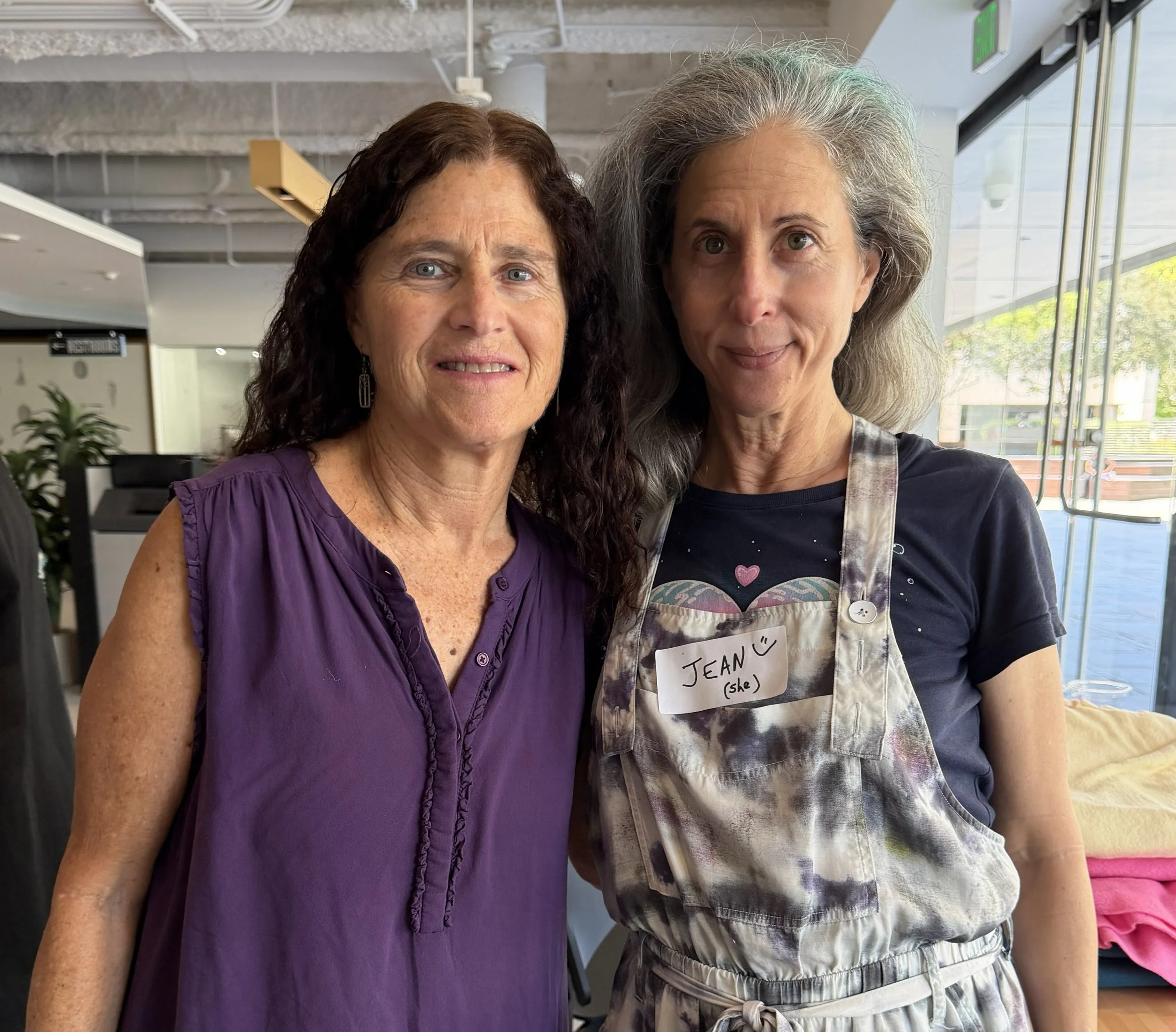
The first thing Jean Franzblau received from her local TimeBank wasn’t a ride, a repaired appliance, or help around the house. It was a haircut. She sat beneath the shade of a park pavilion while another TimeBanking member trimmed her hair. Nearby, someone sharpened kitchen knives. A volunteer glued a broken vase back together. Others repaired torn clothing.
All of this took place at the Repair Cafe, a pop-up event regularly sponsored by Our Time Bank, which serves the Westside of LA. The next one in Santa Monica is coming up on August 15.
No money changed hands. No one rushed anyone else. “It was so joyful,” she says. “More than simple thriftiness, it’s an exchange of love.”
The event offered a glimpse of an economy built on generosity instead of transactions—a place where value wasn't measured in dollars, but in willingness to help. “Capitalism is a yoke; it’s repressive and oppressive. To be free from it, even for those minutes, gave me a huge spring in my step.”
She soon became a member of Our Time Bank, part of an international movement founded in 1980 by legal scholar Edgar Cahn. Created in response to social program cuts during the Reagan administration, TimeBanking rests on a simple idea: everyone’s time is worth the same. Spend two hours helping someone garden, organizing their garage, or driving them to the airport, and you earn two hours you can later use to receive help from someone else.
The accounting matters, but only up to a point. “What TimeBanking does at its core,” she says, “is teach me how to be a good neighbor.”
The lessons arrived at a moment when she was searching for entirely new ways to live. For years, Franzblau has worked in spaces where vulnerability, trust, and communication are everything. She founded Cuddle Sanctuary, a community centered around “hugs and kindness, which on the flip side means boundary and consent practices,” she explains. When she returned from performing her one-woman show across the country, several people sent her the same 2018 article, urging her to train as a Hollywood intimacy coordinator, a much-needed response to Me Too. “I’m comfortable being on the bleeding edge of where the culture meets the unknown, voicing what many people would rather avoid,” she says.
Climate change became the next uncomfortable subject she couldn’t look away from.
On impulse, she borrowed Greta Thunberg’s The Climate Book from the library. “Halfway through the book, I began connecting the dots,” she says. “I started to freak out—which is an appropriate response to what’s happening.”
Instead of processing her fear alone, she invited friends and colleagues to form a climate learning salon. “We read one essay every week,” she says. “Discuss it, digest it, feel our feelings, and then come back next week for the next one.”
After the group’s first gathering, devastating fires transformed climate change from an intellectual concern into an immediate reality. Franzblau, who doesn’t own a car, texted the friend of a friend to ask for a pick-up if evacuation became necessary. “Those little typing dots appeared, not an immediate yes, the way I imagine a family member would respond.”
The pause stayed with her. “I knew I needed to change and strengthen my community network, and, simultaneously, I felt drawn to connect to my indigeneity as a human being on this planet. She saw the two impulses as two sides of the same coin. Jean began volunteer gardening, putting her fingers on the pulse of the land, literally and figuratively. As she explored ecological living, intentional communities, and mutual aid, an unfamiliar phrase appeared. TimeBanking. She googled and found a chapter in West LA.
The entry point wasn’t a meeting or a membership form—it was a potluck. Jean asked herself, What could I offer? And what do I need?
The answers weren't immediately obvious. Like many people, she was accustomed to giving. But TimeBanking isn’t a charity. After joining, she hesitated before making her first request. She had two upcoming flights and noticed members offering rides to the airport.
Because money wouldn’t change hands and there wasn’t a larger corporate structure, she had some initial trepidation. The chapter’s volunteer coordinator walked her through the website, explaining which members preferred early mornings, who drove electric vehicles, and who had the most flexible schedules. Jean asked, “‘Who's reliable?’” The answer? “Everyone.”
“It’s complex not to be extractive,” she reflects, including around labor practices. It’s hard to wrap our minds around the fact that we’re “paying” with our previously donated “labor.” Modern life teaches efficiency, convenience, and transactions. Trusting strangers asks for something different.
This trust, she believes, is TimeBank’s real purpose. “It’s sad because we don't already have the community muscles, but since we don’t, the charm of the organization is to help us remember.” Even the name, she jokes, feels like a concession to the culture it quietly resists. “Time banking sounds efficiently capitalistic.”
While the organization keeps track of hours through a simple online ledger, the accounting is almost beside the point. “The website is incredibly simple," she says. "If I help someone declutter for two hours, they transfer two hours to my account. If someone drives me to the airport for two hours, I transfer those hours to them.”
The exchanges aren’t reciprocal between two people, and are asynchronous, the way life unfolds organically. “If I help somebody with gardening, they don't need to help me with paperwork,” she explains. Somewhat akin to the small amounts of money exchanged on Facebook Marketplace, she says, “We’re just moving our hours along.”
Rather than a marketplace, TimeBanking is a trust-building exercise. Members earn hours by helping anyone in the network and spend those hours receiving help from someone entirely different. She might help someone season a cast-iron skillet or spend an afternoon decluttering a neighbor's home. It doesn’t have to be an immediate transaction. One recent request delighted her: a member needed someone to pick up four hot Costco pizzas and deliver them to a Sunday birthday party. Like the beginning of a romcom.
The requests become conversation starters, small windows into one another's lives.
They’re also opportunities to practice something many adults have forgotten: identifying what we need help with and asking for that aid. “It’s hard to reach out to a stranger with ‘Can I help you?’ Or, ‘Can you help me?’”
Terry Silberman agrees that asking is the hardest part of TimeBanking. She has a storehouse of unused credits, but that’s okay. The organization kept her account intact even when her participation dropped off during the Covid pandemic.
She came to TimeBanking fifteen years ago, while working full-time in public health. Enthusiastic neighbors knocked on her door with flyers announcing they were starting a local chapter. She immediately understood the public health implications. “TimeBanking promotes wellness,” she says. “Connection with neighbors, getting to know, value, and respect one another all help to build healthier, stronger communities.”
Like many working professionals, Terry could only participate intermittently. After retiring, she’s become active again and leads orientations for new members.
When her washing machine malfunctioned, another member visited her home and later helped troubleshoot the problem over the phone. A landscaper offered advice. Another neighbor catsat. “We’ve participated in several lovely exchanges,” Terry relayed. “Sharing strawberry plants with a member, assisting a neighbor with a pharmacy pick up, and receiving mending support for items ranging from a backpack to a shoulder bag.” Other exchanges she’s seen: guitar lessons, elder companionship, and tech support.
Our Time Bank also participates in an organic Food Buyers Club, Azure. This allows Time Bank members to share bulk orders and to help other members coordinate pick-up.
New members pay a nominal annual fee of $25, complete a brief profile, attend a community potluck, and participate in an online orientation. At each gathering, people introduce themselves by sharing both what they can offer and what they're looking for. The structure helpfully formalizes a natural inclination to help and be helped asynchronously. The website and potlucks reveal people’s skills that often remain hidden unless we co-create a searchable directory.
On Friday, August 7th, Jean and Terry are co-hosting a workshop at Coffee & Connections on TimeBanking and Home Exchange. “We’re going to play a fun game to break the ice,” they told me. TimeBanking’s power doesn’t simply stem from creating an alternative currency. Like Bahala, it’s an organic structure that holds space, allowing us to exercise rebuilding a deeply human practice: creating a village where giving and receiving flow as naturally as breathing.
Jessica Cole