
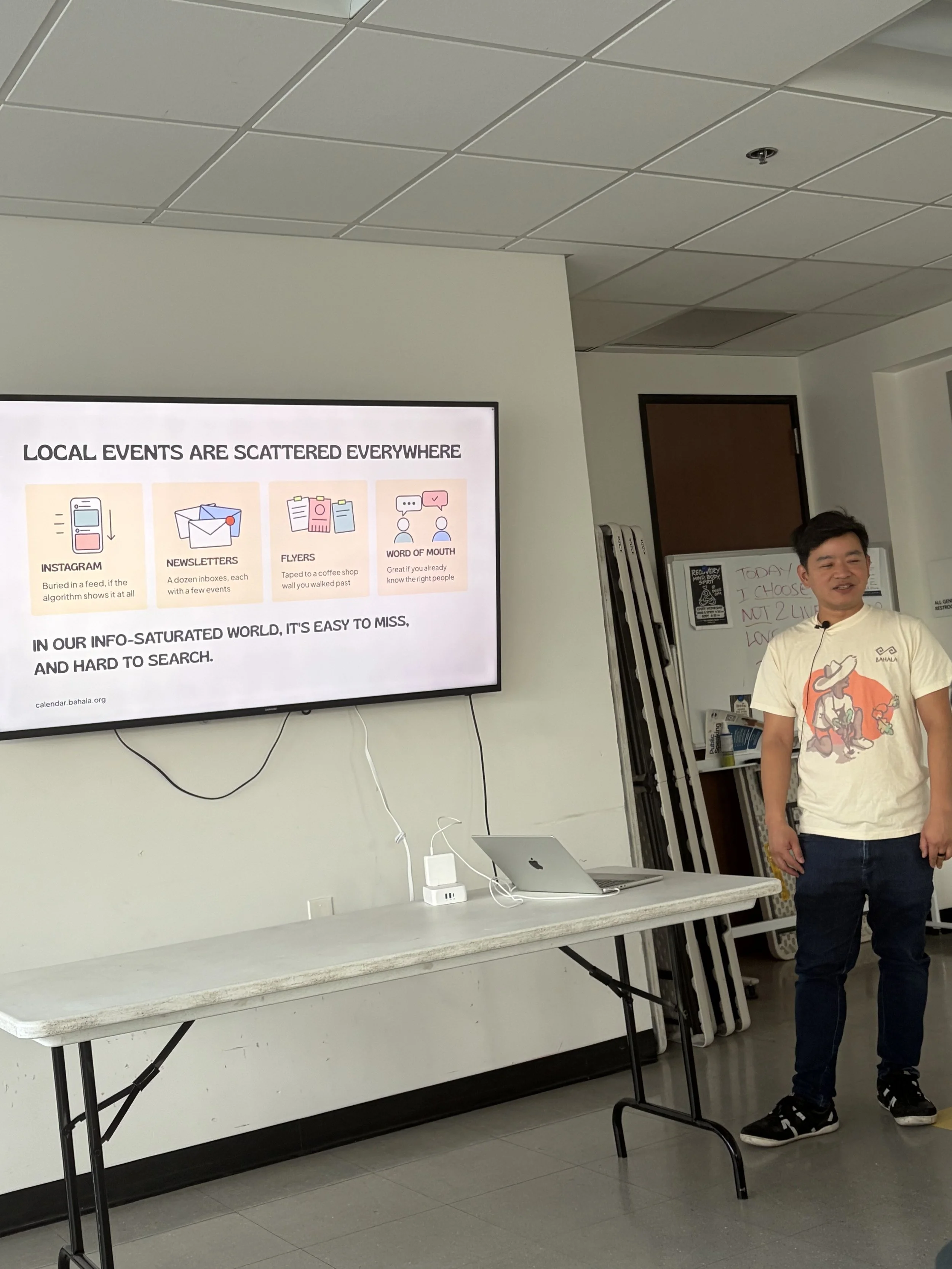
We’re lucky enough to live in a place where there is always something happening. A backyard concert, a pop-up market, a community gathering, an art opening. “But we're in a data-saturated world, which usually doesn’t give us usable information,” Bahala founder Carlo Cabanilla notes. We can follow individual institutions and creators on Instagram, but the algorithm isn’t reliable. Subscribing to local newsletters can clutter up our inbox, or end up in spam. Platforms like Eventbrite cover large geographic areas and big ticket events promoted through ads, so searching for activities in a particular neighborhood requires wading through listings from all over Los Angeles. Most media rewards clicks, not necessarily the creation of stronger local communities.
Bahala is taking a more local and systematic approach with its Neighborhood Calendar. On Oct 12th, we gathered at Tea & Talks to get a taste of this community tool, to ask questions, and to see it in action onscreen. Rather than building another platform that competes for our fractured attention, Bahala created a catch-all of easy-to-find information that’s already out there. Designed to be a local guide, the calendar simply lays out what's happening in our community, and when.
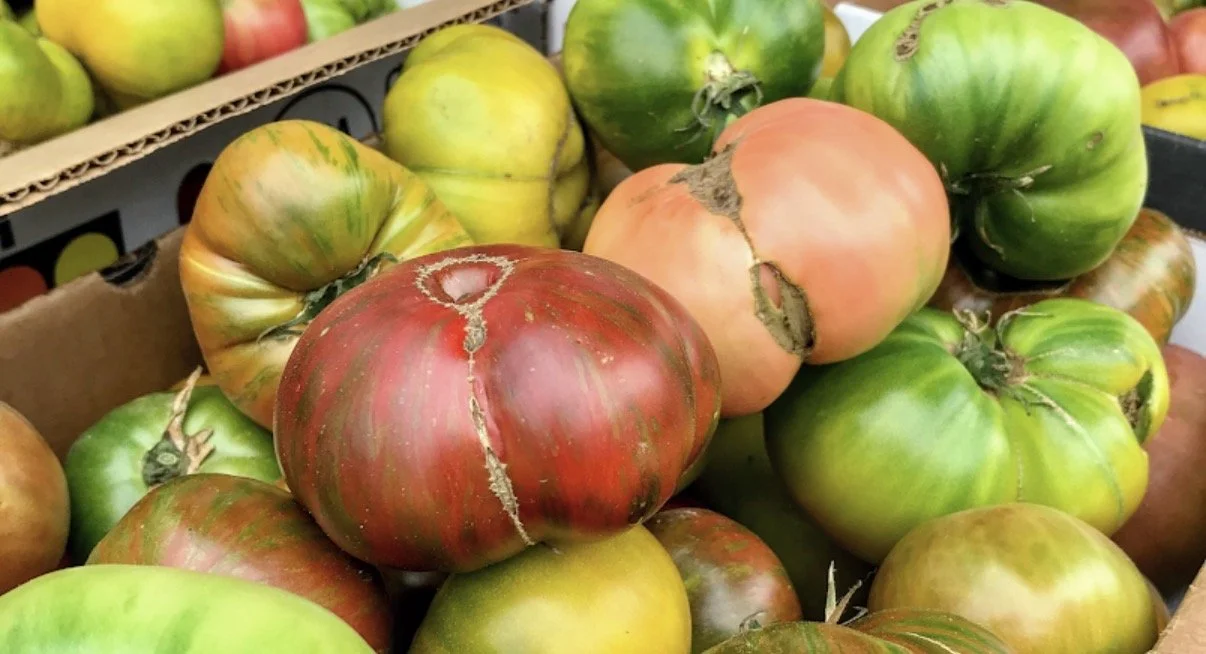
The when of it all is essential. If you're lucky, you hear about an event in time. More often, we find out afterwards. “I saw a flyer for a heirloom tomato tasting, and I was so excited,” Carlo said. “Until I saw that it had happened the day before.” Like homegrown, sun-ripened fruit, the window of enjoying the happenings around us go from abundance to out of season lightning fast.
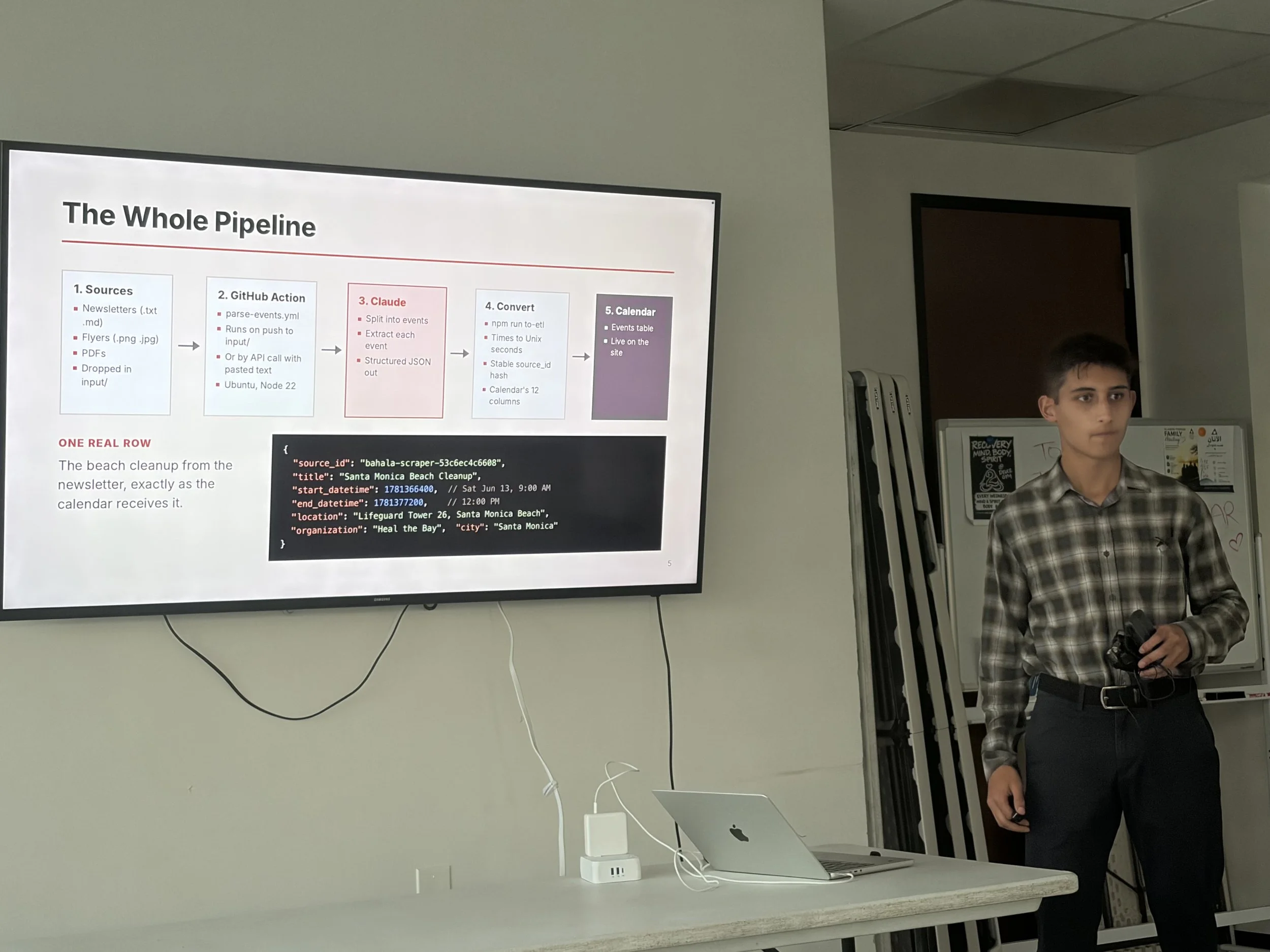
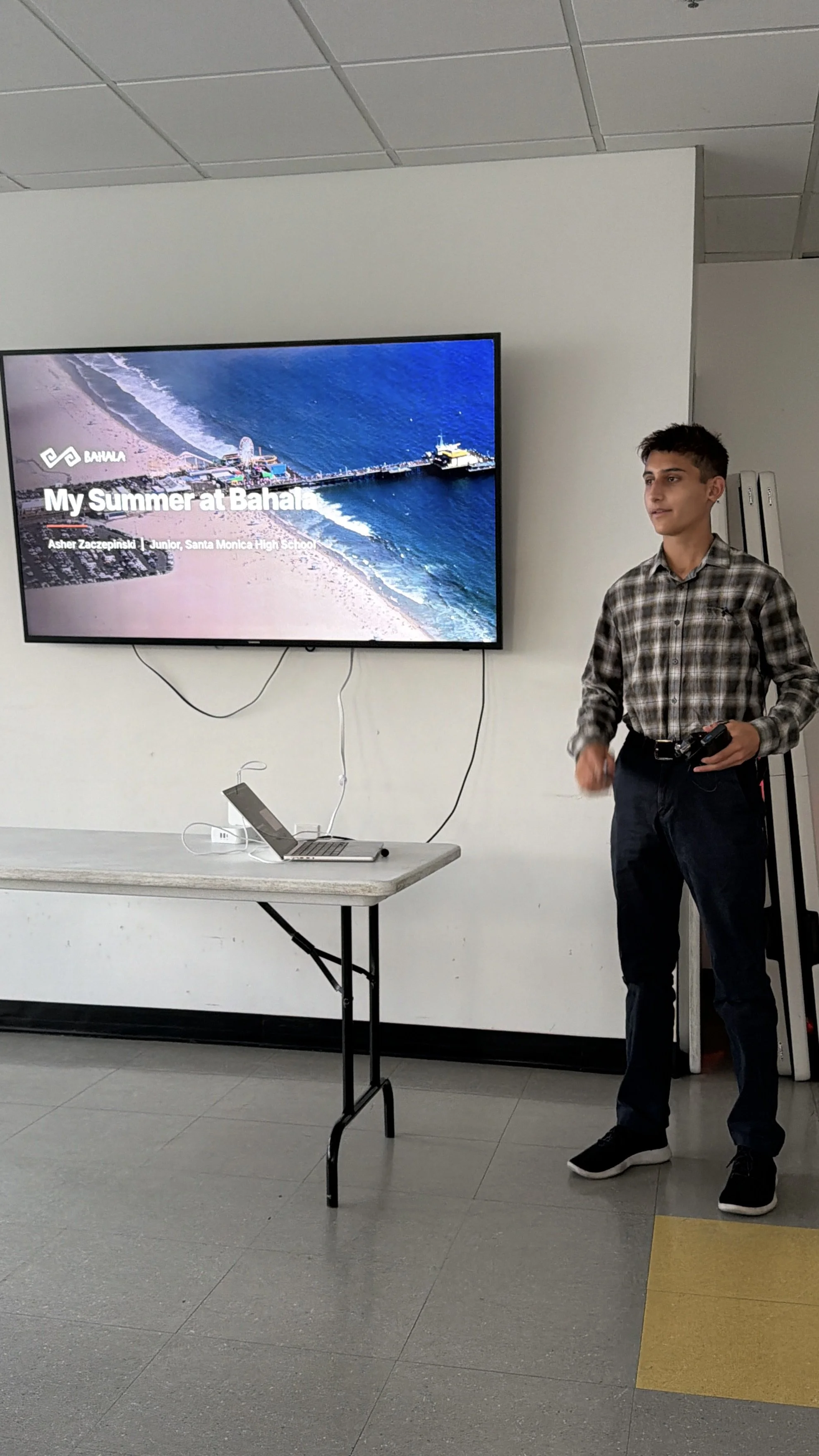
Listing activities with the correct time proved to be more challenging than expected. “We kept checking that events were listed in Pacific time, rather than the default general earth time,” joked Bahala intern Asher Zaczepinski, who’s taking AP Computer Science as a student at Santa Monica High School (SAMO). He worked with Carlo and software engineer Julius Dorfman to build the technical foundation behind the calendar, including how to use AI tools to make the collection and organization of event information more efficient.
Keeping track of events we know about and/or signed up for reminds me of my son’s third grade teacher, Mr. Donovan, who bought his classes paper planners and taught him how to use them to improve their lives, not only as added busywork. He encouraged these eight-and-nine- year-olds to add in class assignments, homework, and field trips, as well as chores from home, music lessons, and sports outside of school, using color-coding and highlighters. Even though that school year was cut short by covid lockdown, it was my son’s favorite year of K-8. The empowerment from learning to organize his activities in one place guides him as a high schooler today.
Because not everyone has a Mr. Donovan (or toggles between several iCalendars!), Bahala’s Neighborhood Calendar events are organized chronologically, with practical information such as dates and whether they're free. There's no account to create and no need to log in just to see what's happening.
The idea is to make room for and reveal the full range of neighborhood life going on under our noses, from yard sales to concerts in the park to gallery openings. The calendar at launch featured a banquet of 122 events and activities in or near Santa Monica for the week of Oct 12th!
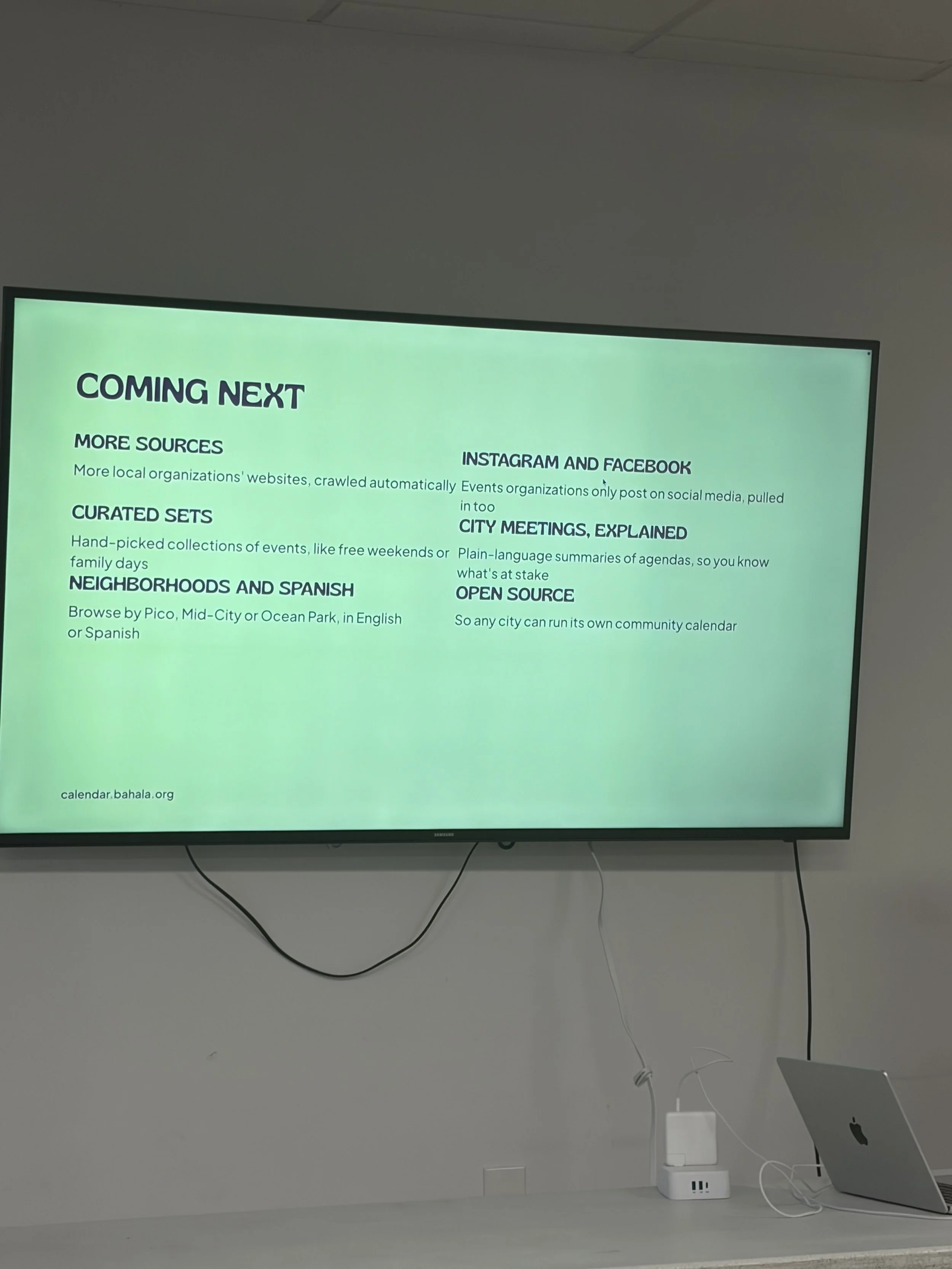
The first iteration of the calendar is already impressive, but the team sees it as a starting point. The next version will focus on making it easier to handle multiple event submissions and more complicated information flows. ““We wanted to begin with a curated calendar rather than immediately build an elaborate taxonomy,” Carlo said. The first priority is getting useful, relevant information in front of people. More ways to sort and discover events will follow.”
A map feature is in development, allowing people to search by neighborhood and by distance. Someone might be willing to travel across town for a special event but would prefer to find something within walking distance for an ordinary Saturday afternoon.
Asher loved co-building the foundation. “There was room to experiment, make mistakes and improve the system without the pressure of being in a job where a bad result in getting fired,” he said. To avoid AI hallucinations, Asher and Carlo learned how to give Claude better instructions, recognize its limitations, and build safeguards around its output. “At first, I didn't fully understand why it was important to preserve the source of an event listing,” Asher said. “But if AI is extracting information from a variety of places, someone needs to be able to trace the original announcement and verify the details.”
Most importantly, the collected and collated information needs to be intuitive and accessible so people use the tool. Graphic designer Bartek Malecki iterated several mock-ups of how events arranged on a page contributed to functionality. He thought through how the calendar behaves on a mobile phone versus a laptop, how much information should appear in each listing, and how the page is set up left to right and top to bottom. “Even how much empty space surrounds the information helps the listings feel approachable rather than overwhelming,” Bartek said.
Currently embedded in Bahala's website, the calendar serves as a centralized resource for the broader community. However, the intention is to eventually open-source the project, making it possible for other people and organizations to contribute to its development. Ideally, the technology will provide a foundation for other communities to adapt to their needs and build upon.
In a world where we're constantly being asked to pay attention to and disregard more and more information, the Bahala Calendar makes it easier to find fun events going on around us. Here’s to 122 opportunities (and counting) to get out and enjoy our lives.
